
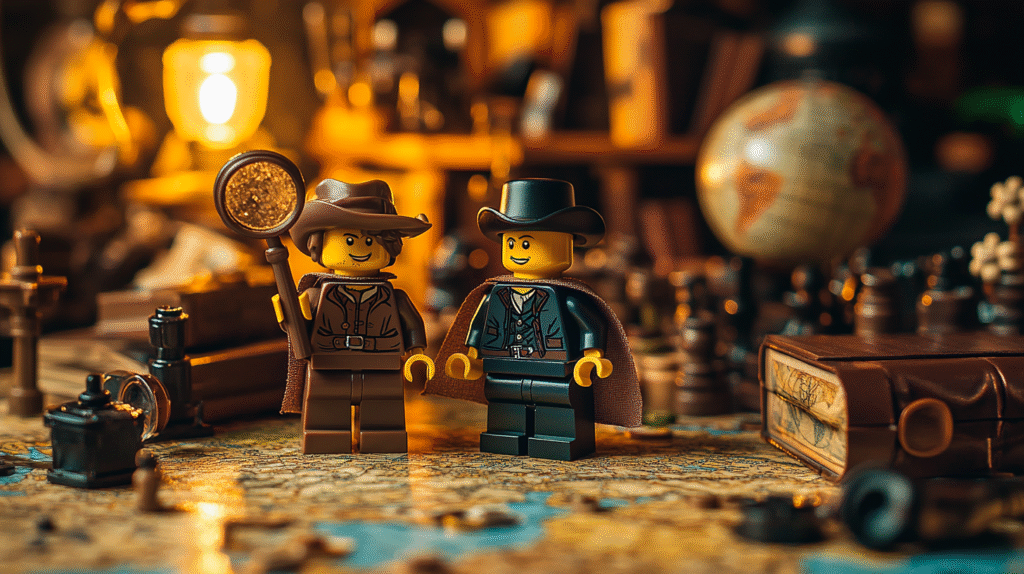
Preschool kids don’t want to sit and listen. They want to move things around. They want to build, color, act out stories. And honestly, that’s how they learn best. Worksheets can be helpful, sure, but when you give a child something to color and something to move, it all starts to click.
That’s where the combo of printable play scenes and minifigs works really well. It’s simple. You print out a themed background—a farm, a zoo, a grocery store—color it in, and then add a handful of minifigs to play out whatever story or idea you’re teaching.
Kids don’t need an elaborate setup. They just need enough of a scene to anchor their imagination. The cow needs a barn. The firetruck needs a street. The astronaut needs a spaceship. When you combine printable pages and a few small figures, you’ve got a mini learning center that’s creative, hands-on, and ready in minutes.
What Makes This Combo Work
Printable scenes are already part of most early learning classrooms. So are toy figures. The trick is bringing them together in a way that makes sense for a lesson.
You’re not aiming for perfection here. You don’t need laminated terrain and 3D buildings. Just a printed road and a few house cutouts are enough to set the stage. What matters more is giving kids an open-ended setup where they can make choices and tell stories.
When a child places a farmer figure next to a pig, they’re exploring relationships. When they drive a truck down a paper road, they’re practicing cause and effect. If you ask a question like “Where should the chicken sleep?” or “What happens if it rains?”, they start making connections.
You can theme a center around almost anything:
- Farms: animals, weather, seasons, chores
- Towns: jobs, buildings, transportation, community helpers
- Space: planets, gravity, robots, counting stars
- Castles: dragons, royalty, bravery, cooperation
I’ve used this setup during centers time and also for quiet morning tasks. Sometimes I make the background ahead of time. Sometimes the kids color their own. Either way works.
If you want minifigs that match your themes better, I’d check minifig.biz. They have a bunch of odd little characters you wouldn’t usually find at a store, like astronauts with different suits, medieval villagers, and even mail carriers.
How to Build Your Own Printable Play World
Here’s a quick breakdown of how to get started.
1. Pick a Theme
Choose a theme that matches what you’re teaching or what your child is into right now. It helps if you have a printable set that matches, but honestly, even a few hand-drawn shapes can work.
2. Print and Prep
Use cardstock if you want it to last longer. Lay out the background on a table or the floor. Tape a few pages together if you need a larger surface. Let kids color it, or prep it yourself if you’re tight on time.
3. Add Figures
Bring in minifigs that fit the scene. If you’re doing a grocery store, get a cashier, a shopper, a few pretend items. For a beach, maybe a swimmer, a crab, and a lifeguard. Don’t stress if it’s not exact. Kids fill in the rest.
4. Let Them Play
Watch how they interact with the setup. You can guide the play with simple prompts like, “Who lives here?” or “What happened when the rocket landed?” But don’t over-control it. The goal is for them to explore freely.
5. Clean Up and Reuse
When you’re done, fold the scene up and store it with the figures. You can pull it out again later, or switch the theme entirely the next day.
Why This Matters
Young kids learn through repetition and movement. They need to see, touch, act, and imagine. Printable play worlds give them a structure without boxing them in. They’re also cheap to make, easy to change out, and don’t require much prep once you’ve done it a couple times.
Minifigs are a big part of what makes the whole thing click. The scale is right. The expressions are simple. And somehow, kids never get bored of them.
I think what really makes this work is that it looks like play to the kids, but it feels like learning to the adults. And that’s what early childhood learning should be—a blend of both.
Tips for Teachers and Parents
If you’re a teacher setting up centers, you can rotate printable scenes weekly to match your curriculum. Keep a small container of minifigs near each station. Label it clearly so cleanup doesn’t get chaotic.
If you homeschool, you can build a whole week’s lessons around one theme. For example, if you do “Space,” your printable play world can be a launch pad one day and a space station the next. The same figures can do different tasks depending on the story.
I’ve found that kids love adding their own drawings too. One of my students once taped extra trees to the edge of the farm scene and said it was an orchard. Another cut out little flags to mark the moon landing.
If you want to build out your minifig collection to fit more themes, minifig.biz has a wide selection. It’s not all superheroes and robots. There are doctors, animals, villagers, and some pretty odd figures that end up being perfect for this kind of thing.
Final Thoughts
Printable play scenes plus a few good minifigs can turn any corner of your classroom or living room into a little world of its own. It’s affordable, adaptable, and most importantly, it keeps kids engaged without staring at a screen.
You don’t need to overthink it. Pick a theme, print a background, toss in some characters, and let your kids do what they do best—pretend. Ask them questions. Join in once in a while. Watch what happens when you step back and let them build the story.
And when you’re ready to add more figures to your collection, I usually go to minifig.biz. They’ve got just the right mix of serious, silly, and strangely useful.