
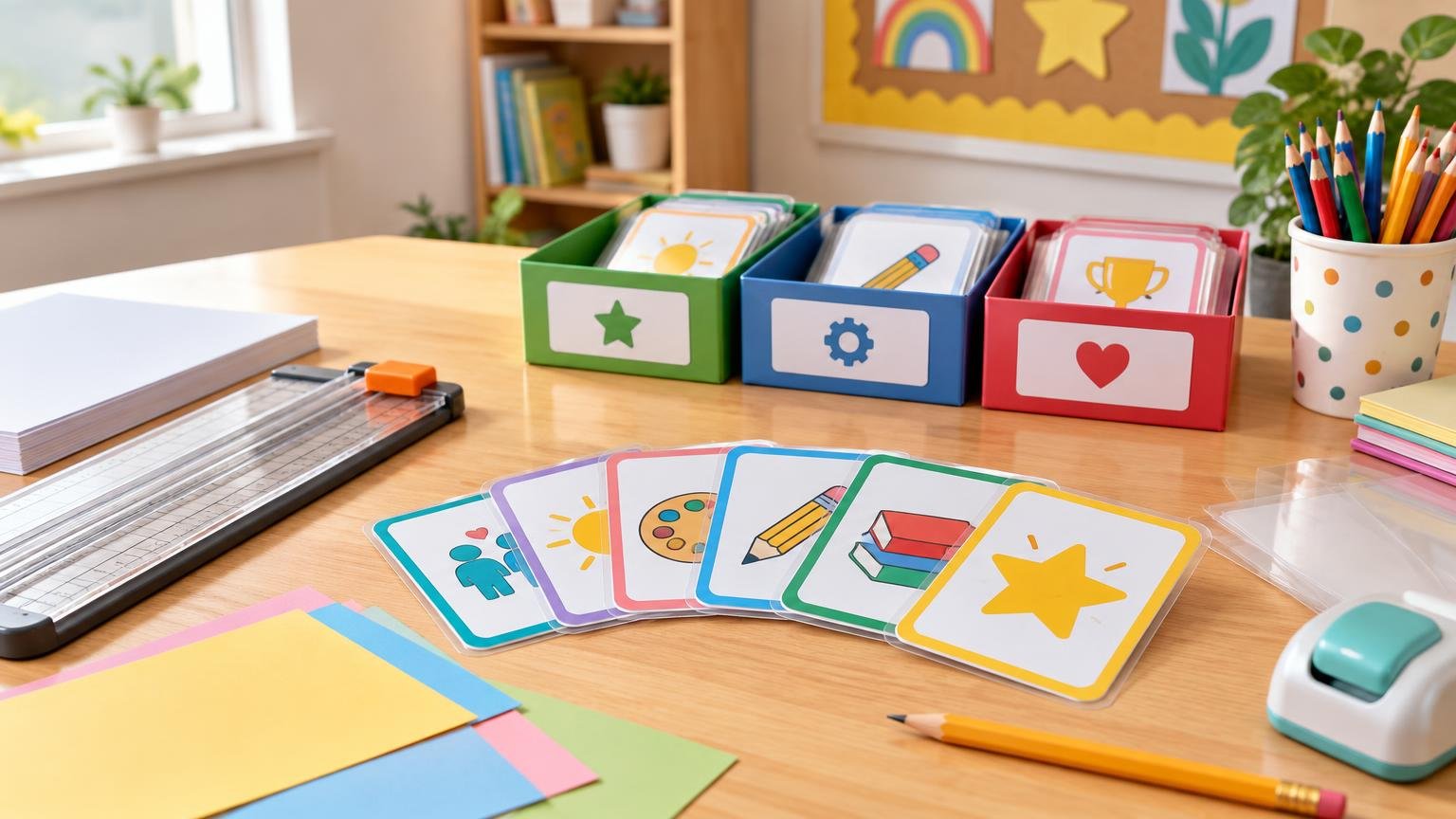
TLDR: Effective printable classroom coupons name one clear privilege, explain when it can be used, and include enough information to prevent redemption disputes. Print short-term coupons on ordinary paper or frequently handled cards on printer-compatible cardstock. Add expiration and tracking fields only when they solve a real management problem. Laminate reusable cards before trimming them, then collect and store them after redemption.
Printable classroom coupons can offer low-cost recognition without filling a prize box with trinkets. The most manageable systems use a small reward menu, connect each coupon to a clearly stated expectation, and establish redemption rules before any cards are issued.
Coupons are one optional recognition tool, not a complete response to persistent behavior concerns. The What Works Clearinghouse practice guide on teacher-delivered behavioral interventions recommends acknowledging expected behavior with positive attention, behavior-specific praise, and rewards. It also recommends teaching expectations explicitly and reducing reinforcement frequency as expected behavior becomes established. Formal reinforcement systems similarly sit within broader positive behavioral supports rather than replacing them.
What to put on printable classroom coupons
A student should be able to look at a coupon and understand what it provides. Keep the front focused on the reward instead of filling it with rules. Put longer conditions on a classroom reward menu or on the back of a larger card.
- Reward name: Lead the line, choose a read-aloud, or use a special seat.
- Student name: Useful when coupons are not transferable.
- Earned for: An optional field for a brief, specific acknowledgment.
- Date issued: Helps resolve old or duplicated coupons.
- Teacher initials: A quick authenticity check for occasional rewards.
- Redeem by: Use this only if coupons expire.
- Coupon ID: Helpful for higher-volume systems or privileges that require scheduling.
For early readers, pair a short phrase with a simple, consistent icon. A chair can represent special seating, a book can mark read-aloud choice, and a pencil can indicate drawing time. Use large type, strong contrast, and generous spacing. Avoid relying on color alone because a grayscale copy or color-vision difference can remove that cue.
Choose rewards students can actually use
The best coupon reward is feasible during the school day and genuinely appealing to the student receiving it. Preferred rewards can differ among students, and recognition can be designed for an individual, a group, or the whole class. A short choice menu is usually more practical than one supposedly universal reward.
| Reward type | Low-cost examples | Check before offering |
|---|---|---|
| Classroom privileges | Choose a seat, use a special pencil, be first to select a center | Whether the privilege affects another student's access |
| Helpful roles | Deliver a note, organize materials, assist with setup | Supervision, confidentiality, and physical accessibility |
| Activity choices | Choose a brain break, drawing prompt, read-aloud, or review game | Available time and whether the choice fits the lesson |
| Social connection | Lunch with a teacher-approved group, share a joke, show a project | Student comfort, scheduling, and school rules |
| Group rewards | Select a class song, movement break, or closing activity | Noise limits and whether all students can participate |
Connect the coupon to the expectation with specific language: “You returned the materials to the labeled bins, so you earned a helper coupon.” That is clearer than “You were good.” Keep the praise even when the card itself must stay brief.
Review every reward against school policy, classroom routines, accommodations, and individual student plans. Homework passes, food, extra recess, technology time, seating changes, and access to restricted spaces may not be appropriate or permitted. Offer an accessible alternative when a student cannot comfortably or safely use a particular privilege.
Set redemption rules before printing
Rules should protect instruction time without making a small reward difficult to use. Decide which limits your room actually needs, then print only those. Possible rules include teacher approval, one redemption at a time, a daily or weekly cap, and blackout periods during assessments or direct instruction.
- Timing: State whether the coupon may be used immediately, during a designated period, or after scheduling.
- Saving: Decide whether students may accumulate coupons or must use them within a set window.
- Transfer: Allow sharing only if it will not create pressure, trading disputes, or unequal access.
- Lost cards: Choose whether lost coupons are replaced, checked against a log, or treated like lost tickets.
- Copies: Require initials, an issue date, or a coupon ID if photocopying becomes a concern.
- Redemption: Mark, punch, tear, or collect single-use cards as soon as the privilege is scheduled.
There is no universal correct weekly limit. Start with a rule that matches how often coupons are issued and how much class time the rewards require. For example, a student might hold several recognition cards but redeem only one scheduling-heavy privilege per day. Review the limit after a week or two and simplify it if tracking creates more work than the system saves.
Should classroom coupons expire?
Expiration is an operational choice, not a requirement. It can prevent a large stack from arriving at the end of a term and make scheduling more predictable. On the other hand, a very short window can undermine the reward when absences, support schedules, or busy school days leave no reasonable chance to redeem it.
Flexible options include a blank “Redeem by” line, use within five school days, use by the end of the month, or use before a clearly stated term deadline. If a coupon expires, make the date prominent when it is issued and provide a fair procedure for days when the privilege was unavailable through no fault of the student.
Use the simplest tracking method that works
For an occasional coupon, teacher initials and a date may be enough. A busier system can assign sequential IDs and record the student, reward, issue date, redemption date, and staff initials. Keep the log concise; avoid adding sensitive behavior notes to a portable sheet, and follow school procedures when a tracker contains student information.
A punch card is another option when the reward depends on repeated acknowledgments. It reduces loose paper, although it offers less flexibility than individual cards. A reusable token system can be even simpler: issue a laminated privilege card, record the reward separately if necessary, and collect the card when it is redeemed.
Best sizes and layouts for classroom coupon cards
| Finished size | Best use | Layout advice |
|---|---|---|
| About 3.5 × 2 inches | Compact individual privileges | Keep the reward name large and limit handwriting fields |
| 3.5 × 2.5 inches | Coupons needing a name, date, and redemption line | Use one side for the reward and the other for brief rules |
| Quarter page | Young readers, group rewards, or more instructions | Add a large icon and generous writing space |
| Half sheet | Whole-class privileges or display-based rewards | Use when the card must be read from farther away |
Before duplicating a full page, print one sheet at actual size. Cut out a sample, write in every field, place it in the intended storage container, and ask whether the reward can be identified at a glance. A screen preview will not reveal cramped handwriting areas or text that becomes too small after cutting.
Paper, cardstock, and test prints
Ordinary copy paper is suitable for single-use coupons that will be collected quickly. It is inexpensive, folds easily into student folders, and works well for testing a new system. Cardstock is better for reusable cards, reward menus, and coupons that may spend several days in a desk or backpack.
Printer compatibility varies by machine, so check the exact manual rather than assuming every printer accepts the same cardstock. One Epson model, for example, documents support for cardstock up to 68 lb or 256 g/m², but that specification applies to that model and is not a universal limit. Check supported weight, paper path, tray instructions, and print-side requirements before buying a large pack.
- Print a draft on plain paper using the final page size and scaling settings.
- Confirm that nothing crosses the printer's non-printable margin.
- Hold the sheet to a light source to check front-and-back alignment if printing duplex.
- Try one cardstock sheet through the manual or recommended feed path.
- Let heavily inked sheets dry before stacking, cutting, or laminating.
A low-ink version should remain usable without colored backgrounds. Use black outlines, unfilled icons, and perhaps a small color stripe rather than flooding the entire card. If you need many professionally finished sheets or consistent bulk production, compare your preparation time and equipment limits with online professional printing before committing to a large home-print run.
How to laminate and cut coupons
Lamination is worthwhile for reusable privilege cards, reward menus, and cards handled by many students. It adds stiffness and wipeability, but it also adds cost, bulk, glare, and preparation time. Single-use paper coupons rarely need it.
For thermal pouches, 3M advises against cutting the pouch before lamination. Place multiple cards in one pouch with space between them, laminate the full pouch, allow it to cool flat, and then trim the pieces. Leave a clear sealed border around each card; cutting into the paper edge can break the seal and allow the layers to separate.
- Rough-cut printed cards only if needed to arrange separate pieces inside the pouch.
- Leave even gaps between pieces so each card can retain a sealed edge.
- Run the closed end of the pouch into the laminator first, following the machine instructions.
- Place the hot sheet on a flat surface until it cools.
- Trim with a paper cutter for consistent edges.
- Round sharp corners if the cards will be handled frequently.
Dry-erase marks can be used on laminated documents, according to 3M. This makes a blank name or date field reusable, but dry-erase writing can rub off in a pocket or folder. Keep a separate log for any information that must survive handling, and test the marker and cleaning method on one card first.
Store unused, active, and redeemed coupons separately
Divide storage by status. Keep unused cards in labeled envelopes, an index-card box, or a small drawer organizer. Give issued coupons a predictable home such as a student folder or classroom pocket chart. Put redeemed cards in a collection envelope until the tracker is updated. Return laminated reusable cards to their original category after cleaning.
Store the digital files just as deliberately. Keep an editable master for changing reward names and a print-ready PDF for reliable reprinting. Add a revision date to the filename, and archive old versions when rules change so outdated coupons do not quietly re-enter circulation.
A practical coupon template
Start with one page containing six to ten cards, depending on the chosen size. Give every card the same structure: a bold reward title, one recognizable icon, a student-name line, a short “earned for” line, an issue date, teacher initials, and an optional redemption deadline. Create both color and black-and-white versions.
Build only four to eight reward designs for the first trial. Print them on plain paper, explain the rules, and note which privileges are easy or difficult to schedule. Revise the wording and reward menu before spending time on cardstock or lamination. A small, predictable system is easier to manage than a large collection of attractive cards with unclear conditions.
Printable classroom coupon FAQ
Can students share or trade coupons?
They can if the teacher deliberately permits it, but non-transferable cards are simpler to administer. If sharing is allowed, prohibit pressured trades and make sure transferred privileges remain accessible and appropriate for the receiving student.
What happens when a coupon is lost or damaged?
Use the rule selected before issuing cards. Occasional systems might replace one damaged card with teacher initials. Logged systems can verify an ID and reissue it. Whatever the rule, state it consistently rather than deciding only after a dispute occurs.
Do coupons need to be laminated?
No. Use plain paper for short-lived rewards and cardstock for cards needing more structure. Reserve lamination for reusable cards or items expected to receive frequent handling.
How many coupons should students redeem each week?
Choose a limit based on issuance frequency, scheduling demands, and instructional time. A cap may be unnecessary for quick rewards but useful for privileges requiring staff attention or changes to the daily routine.
Start with a small, testable system
Choose a short menu of policy-compliant rewards, write the redemption rules in plain language, and test one paper sheet before producing a full set. Add cardstock, lamination, expiration dates, and ID tracking only when those features fix a problem you actually have. The strongest classroom coupon system is not the most elaborate one; it is the one students can understand and adults can administer consistently.