
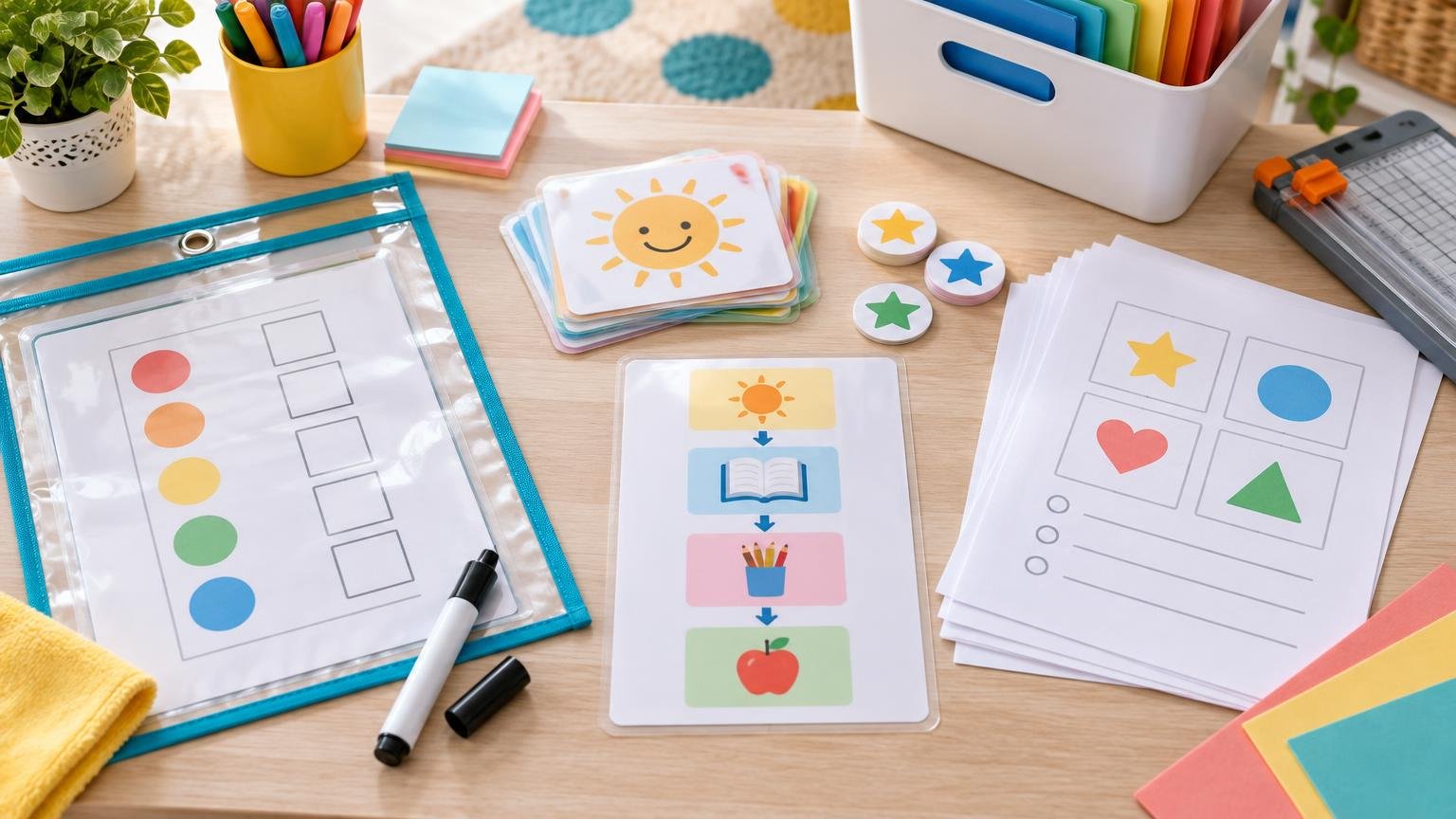
TLDR: Laminate stable materials that will be handled repeatedly, exposed to spills, or used across multiple groups. Skip lamination for one-time worksheets, frequently changing information, most take-home papers, and anything that is cheaper and faster to reprint. Use dry-erase pockets for full-page activities, cardstock for light reuse, and weather-rated materials for long-term outdoor signs.
If you are wondering what classroom materials should be laminated, start with frequency and replacement effort—not with the type of printable. A visual schedule used every school day is a much stronger candidate than a worksheet completed once. The goal is to spend laminating time only where the added durability will save more work later.
Lamination is useful, but it also adds pouch cost, machine time, cutting, storage bulk, glare, and eventual disposal. A selective approach keeps your most-used resources intact without turning every sheet of paper into a permanent classroom object.
The quick lamination decision
Before laminating an item, ask these questions:
- Will it be used by several students, groups, or future classes?
- Will a tear, spill, or bent corner make it unusable?
- Does it need to be written on and wiped off repeatedly?
- Is the information stable enough to keep for a semester or longer?
- Would cardstock, a sheet protector, or a reusable pocket provide enough protection?
- Will the item be exposed to rain, direct sun, food, frequent cleaning, or another condition that requires a purpose-built material?
- Will cutting and storing the laminated pieces take more time than replacing the item?
A practical rule is to laminate when you can answer yes to the first four questions and no to the last one. If the content may change soon, use removable protection instead.
What classroom materials should be laminated by use pattern?
| Use pattern | Default choice | Why | Useful alternative |
|---|---|---|---|
| Used once | Do not laminate | The pouch and preparation usually cost more time than reprinting | Ordinary paper |
| Sent home | Usually do not laminate | Families may need to write on, sign, file, or recycle the paper | Paper or light cardstock |
| Used weekly | Laminate selectively | Protection can help small cards and shared directions, but not every page needs it | Cardstock or sheet protector |
| Used daily | Usually laminate stable items | Repeated handling makes torn edges, spills, and bent corners more likely | Durable cardstock for items that remain posted |
| Used with dry-erase markers | Test before committing | Marker removal varies by pouch, marker, eraser, and time left on the surface | Dry-erase pocket or purpose-made write-and-wipe sleeve |
| Used outdoors | Do not rely on ordinary classroom lamination long term | Sun, water, heat, mounting, ink, and edge sealing all affect durability | Weather-rated sign media or replaceable temporary signs |
| Shared and frequently touched | Protect only if it helps the actual workflow | A wipeable surface may be convenient, but cleaning still requires an appropriate process | Multiple paper copies or a rigid reusable sleeve |
Strong candidates for lamination
Frequently handled materials with stable content generally provide the best return on the time spent laminating. Manufacturers market standard classroom pouches for frequently used documents and protection from tears and spills, which fits this type of use.
Visual schedules and routine cards
Daily schedule icons, first-then cards, classroom routine prompts, and choice cards are often moved, pointed to, carried, or attached with hook-and-loop dots. Lamination can prevent the corners from softening and give small pieces enough stiffness for easier handling. Leave sufficient clear border around each piece so the sealed edge is not cut away.
Task cards and learning games
Task cards, matching sets, reusable game boards, number cards, and alphabet cards are good candidates when several groups will use them. Print a single trial set before preparing an entire class pack. That check can reveal text that is too small, answers that need correction, or cards that should be resized.
Cardstock may be enough for lightly used cards. Laminate when the set will circulate frequently, includes many small pieces, or would be inconvenient to print and cut again. Store completed sets in labeled envelopes, zipper pouches, or small containers so the extra durability does not create an organization problem.
Center directions and desk references
Stable center directions, keyboard guides, number lines, letter-formation references, and recurring small-group instructions can benefit from protection. Lamination makes the most sense when the same resource will remain in use for months. Put changing instructions in a sheet protector so you can replace the insert without discarding the plastic.
Reusable reward and organization pieces
Frequently handled tokens, passes, durable labels, and reusable classroom coupons may last longer when laminated. For supply bins, bottles, folders, or equipment that need adhesive identification rather than loose cards, custom classroom stickers can be a more practical format than attaching laminated paper.
Materials that usually should not be laminated
Most consumable or short-lived classroom papers should remain unlaminated. Common examples include:
- one-time worksheets and coloring pages;
- exit tickets, quizzes, and rough-draft pages;
- family letters, permission slips, and forms requiring signatures;
- temporary seating charts or schedules that change often;
- short-term event notices and seasonal decorations;
- student work intended for notebooks, portfolios, or binders;
- certificates that will be sent home and stored rather than repeatedly handled.
Sent-home materials deserve particular restraint. Lamination adds weight and expense, can make a page awkward to write on, and may prevent it from entering the local paper-recycling stream. If a family needs a recurring reference such as a routine chart, consider sending it on cardstock or asking whether a durable version would actually be useful.
Choose protection based on the real job
Lamination is only one way to extend the useful life of a printable. Match the protection method to how the material will be used.
- Cardstock: Best for cards, signs, certificates, and manipulatives that need stiffness but only light or moderate protection.
- Sheet protectors: Best for binder pages, changing instructions, checklists, and occasional write-and-wipe activities.
- Dry-erase pockets: Best for full-page worksheets used repeatedly. The paper insert can be corrected or replaced without making another laminated copy.
- Clear sleeves or badge holders: Useful for name cards, station labels, passes, and small references that change.
- Frames or sign holders: Good for posted information that needs a polished appearance and occasional updates.
- Self-sealing pouches: An option when heat or a laminating machine is unavailable. These provide a permanent covering without the machine step.
- Digital display: Better for information that changes during the day, provided students can access it when needed.
- Weather-rated sign material: The appropriate direction for outdoor displays expected to survive extended exposure.
Cardstock and lamination are not interchangeable. Cardstock adds stiffness, while lamination primarily adds a protective plastic surface. Combining them creates a rigid item, but it also increases bulk. That can be helpful for a small set of daily schedule cards and excessive for dozens of full-page activities.
Be careful with dry-erase markers and cleaning
Do not assume every thermal pouch will behave like a purpose-made dry-erase surface. Test the exact pouch, marker, and eraser together, then leave a sample mark for the length of a normal class period or overnight. If residue remains or the surface becomes cloudy, use a dry-erase pocket instead. Test before producing a full class set.
Cleaning and disinfecting are also different tasks. The CDC guidance for early care and education settings recommends choosing products appropriate for the surface and cleaning before sanitizing or disinfecting when those additional steps are needed. It also notes that shared, high-touch objects may require attention based on actual use. Follow school or district procedures rather than treating lamination as a germ-proof finish.
Cleaner compatibility depends on the pouch. For example, 3M advises testing household cleaners on a small corner of its thermal pouches and warns against acetone. Check the pouch manufacturer's instructions before applying a cleaner to an entire classroom set.
Outdoor signs require a different standard
Ordinary classroom lamination can help a temporary sign survive a brief splash, but it should not be presented as a long-term weatherproofing method. Water may enter through trimmed or damaged edges, while sun and heat can affect the print, adhesive, plastic, and mounting method.
Purpose-built overlaminating films are separately specified for UV exposure and protection against print fading, demonstrating why an indoor pouch and an outdoor finishing system should not be treated as equivalent. For a long-term playground, pickup, garden, or entrance sign, use outdoor-rated print media and finishing. For a one-day event, a replaceable sign in a protected holder may be cheaper and easier.
A budget-conscious prep workflow
Avoid laminating an entire packet before you know that it works. Use this sequence instead:
- Print one sample at the intended size.
- Check readability, contrast, answer accuracy, and cutting lines.
- Use the sample during the activity if possible.
- Decide whether ordinary paper, cardstock, a sleeve, or lamination matches the expected use.
- Confirm that the pouch thickness and item fit your laminator's specifications.
- Laminate the smallest useful quantity rather than making speculative extras.
- Label and store the completed set immediately.
This workflow treats preparation time as part of the cost. A set is not truly reusable if pieces disappear, updated instructions make it obsolete, or the teacher has no practical place to store it.
Frequently asked questions
Is it worth laminating worksheets?
Usually not for worksheets completed once. For repeated practice, place the page in a dry-erase pocket or sheet protector. Laminate only when the activity has stable content, will be used frequently, and works well with the chosen marker.
Should flash cards and task cards be laminated?
Laminate cards used daily or passed among many students. Cardstock is often sufficient for personal sets, short units, or cards used under adult supervision. Test the size and content before finishing a large batch.
Can laminated paper be recycled?
Do not assume it belongs in paper recycling. The EPA's recycling guidance says paper with shiny or laminated coatings may not be recyclable and recommends checking local guidance. Acceptance varies by recycling program.
Should take-home materials be laminated?
Only when the material is intended for sustained reuse and the durable version will genuinely help the family. Letters, forms, ordinary homework, and temporary notices should generally remain on paper.
Make lamination earn its place
The best candidates are stable resources used daily or weekly across multiple students: visual schedules, routine cards, task cards, game pieces, desk references, center directions, and frequently handled organizational tools. Skip one-time, fast-changing, or easily replaced papers.
For your next preparation session, divide materials into four piles: paper, cardstock, removable sleeve, and laminate. That simple sorting step will reduce unnecessary pouch use while directing your time toward resources that genuinely need protection.
References
- Scotch™ Thermal Laminating Pouches, 3 mil Size | 3M United States
- Scotch™ Self-Sealing Laminating Pouches | 3M United States
- How To Clean and Disinfect Early Care and Education Settings | Water, Sanitation, and Environmentally Related Hygiene (WASH) | CDC
- 3M Science. Applied to Life.™
- How Do I Recycle Common Recyclables | US EPA